



Dinnteco DDCE air – Ultra-Lightweight Lightning Protection for Streetlights & Masts
A 0.8 kg DDCE for lighting towers, streetlights, traffic lights and other low metal structures.
Request price
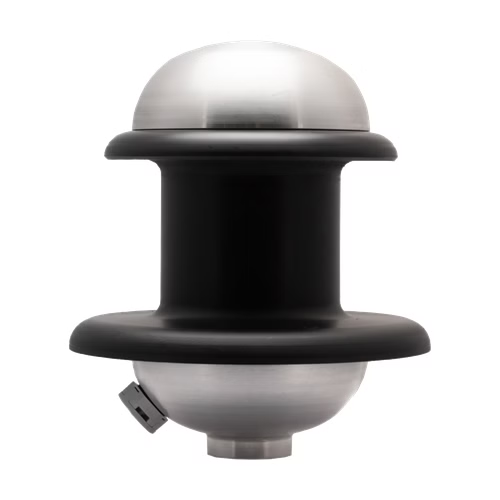
The Dinnteco DDCE air is an ultra-lightweight DDCE device — just 0.8 kg — made for low metal structures and small metal masses that can generate upward streamers in a storm: lighting towers, streetlights, traffic lights and similar. Made by Dinnteco (Spain), which has more than 20 years of experience, over 10,000 units installed and a presence in more than 40 countries.
At a glance
- Model: Dinnteco DDCE air
- Type: Lightning prevention device (DDCE technology)
- Protection radius: the structure it is fitted to
- Maximum structure height: up to 10 m
- Material: aluminium / POM
- Weight: 0.80 kg
- Warranty: 5 years (manufacturer)
Why choose it
- 0.8 kg — easy to retrofit on existing poles without new fixings.
- Made for low metal structures up to 10 m tall that often go unprotected.
- Prevents strikes rather than attracting them to the pole.
- Supplements a main system on larger sites (lateral protection).
- 5-year warranty.
Specifications
- Model: DDCE air
- Material: aluminium / POM
- Weight: 0.80 kg
- Protection radius (Pr): the structure to be protected
- Maximum structure height: up to 10 m
- Recommended use: specific structures up to 10 m high; lateral protection; supplement to a primary protection system
- Warranty: 5 years
- Certifications: patented technology, including Indian Patent No. 425967; certified product (DDCE: ES 140752); ISO 9001 (Bureau Veritas), ISO 45001 and ISO 14001 (SGS); IEC 62305-1, IEC 61400-24 and IEC 62561-1 among its listed standards; CE marked (2014/35/EU, 2014/30/EU); RoHS compliant; NATO/OTAN NCAGE code SYN37; salt-spray (UNE EN ISO 9227) and vibration (IEC 60068-2-6) tested
How DDCE prevention works
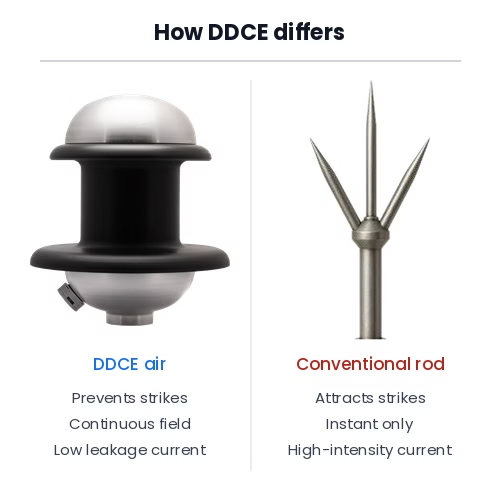
A conventional lightning rod — and an ESE (early streamer emission) arrester — is designed to attract the strike and carry its current to earth. The DDCE works the other way round: it continuously balances the electric field that builds up between a storm cloud and the structure, keeping it below the level at which an upward leader forms, so the strike is prevented from landing on the protected area.
Its patented design (Government of India Patent No. 425967, "Device for balancing variable electric fields") lets a controlled, low-intensity leakage current flow to earth all the time a storm is overhead, instead of the single high-intensity discharge a rod has to survive.
Where it is used
- Streetlights and high-mast lighting
- Traffic signals and gantries
- Stadium and yard lighting towers
- Small metal structures up to 10 m tall on industrial sites
DDCE compared with a conventional lightning rod or ESE arrester
- Prevents lightning strikes on the structure — a conventional rod or ESE arrester attracts them.
- Continuously compensates the changing electric field — a rod only acts at the instant of the strike.
- Reduces electrification, corona effect and electromagnetic pulses in the protected structure — an attracted strike increases them.
- Generates a controlled, low-intensity leakage current — an attracted strike sends a dangerous, high-intensity current down the conductors.
Proven in the field
- Telecom operator field trial, Indonesia — with a 34% lightning-fault rate across its sites, the operator installed more than 200 units each of three technologies and compared them after one year: DDCE sites went to 0% faults, a dissipation-array (DAS) system reached 26%, and active (priming/ESE) rods rose to 36%. (Dinnteco published case study.)
- Endesa (Enel) substation near Barcelona, on a hill locally nicknamed "the lightning hill" — no direct strikes on the substation after one DDCE was fitted to an HV tower; Enel then protected four HV towers on a line north of the city. (Dinnteco published case study.)
- Chikyu, described by Dinnteco as the largest oceanographic vessel in the world (JAMSTEC, Japan) — no incidents reported since a DDCE was installed at its highest point. (Dinnteco published case study.)
- Ushiku Daibutsu (Japan) — a DDCE 100plus protects the statue and the telecom equipment at its top after an earlier strike brought down a 5 m piece of the Buddha's hair; no recorded strikes since. (Dinnteco case study and catalogue.)
- Petrochemical plant, Texas (USA) — DDCE 100plus, 50plus and air installed in 2023: 0 recorded strikes. (Dinnteco catalogue.)
- Telecom site, Bilbao (Spain) — DDCE 100plus installed in 2016: 0 recorded strikes. (Dinnteco catalogue.)
Which Dinnteco device do I need?
- DDCE 100plus — flagship, up to 120 m radius, 7 kg: large and critical structures.
- DDCE UL96 — the same 120 m class where a project needs UL 96 listing.
- DDCE 50plus — protection radius up to 60 m, 5 kg: for structures up to 20 m tall, side or complementary protection.
- DDCE 25plus — protection radius up to 30 m, 2.7 kg: for small structures up to 7 m tall.
- DDCE air — 0.8 kg for streetlights, lighting towers and masts up to 10 m tall.
- DDCE magma — stainless steel and alumina for burners, flares and hot structures.
- dinland — no visible device, for heritage and landscape-sensitive buildings.
Related products
- DDCE 25plus — for small buildings
- DDCE 100plus — for the main structures
Frequently asked questions
What is the DDCE air used for?
Low metal structures up to 10 m tall — streetlights, lighting towers, traffic lights — and as lateral protection supplementing a main system.
How heavy is it?
0.8 kg, the lightest device in the DDCE range.
Can it be fitted to an existing streetlight pole?
Its low weight is intended for exactly that kind of retrofit; we will confirm the fixing for your pole.
Does it attract lightning to the pole?
No — it is designed to prevent the strike rather than attract it.
What warranty does it carry?
5 years from Dinnteco.
How to order
Supplied by Jai Enterprises, despatched from Bhilai and Raipur, Chhattisgarh, to sites across India. To request a price, call +91 9340081159 or send an enquiry from this page with the structure type, its height and the area to protect, and we will confirm the right DDCE model, the earthing it needs and the lead time.
Applications
Availability: Enquiry-based — contact us for stock and lead time.